

Kindle publishing income has become one of the most searched side hustles online, promising the chance to earn passive income by self-publishing books on Amazon KDP without ever putting pen to paper yourself. The idea is simple: you outsource the writing, upload the finished product to Amazon, and collect royalties while you sleep. But between the success stories and the warnings about oversaturation, it’s hard to know what’s realistic in 2026.

The truth is that Amazon KDP can generate real income for beginners, but most people earn between $0 and $100 in their first few months, and success depends heavily on your approach to niche selection, keywords, and volume. Programs like Sophie Howard’s Kindle Publishing Income teach you the outsourcing model, where you hire ghostwriters and focus on publishing multiple titles rather than writing them yourself. This model works for some, but it requires upfront investment and a willingness to test and refine your process.
If you’re trying to decide whether kindle publishing income is worth your time or money, this review breaks down how the business model actually works, what you can realistically expect to earn, the costs involved, and whether training programs deliver on their promises. You’ll also learn the difference between low-content and high-content books, how royalty structures affect your profit, and the common mistakes that keep most beginners stuck at zero.
How Kindle Publishing Income Works
Kindle Direct Publishing allows you to create and sell books on Amazon without needing a traditional publisher. The platform handles both digital and physical book sales while you earn royalties based on your pricing choices and format options.
Overview of Kindle Direct Publishing
Amazon KDP is a free self-publishing platform that lets you upload and sell books directly to customers worldwide. You keep control over your content, pricing, and distribution while Amazon manages the sales infrastructure.
The platform supports three main formats. You can publish Kindle ebooks that readers download to their devices. You can also create paperbacks through print-on-demand technology. And you have the option to produce audiobooks through Amazon’s ACX platform.
Your earnings come from two sources. Direct sales give you royalties when someone buys your book. Kindle Unlimited provides additional income when subscribers read your enrolled ebooks, paying you roughly $0.004 per page read.
The royalty structure varies by format. Ebooks priced between $2.99 and $9.99 earn 70% royalties, while books outside this range earn 35%. Paperbacks earn 60% of the list price minus printing costs. This means a $14.99 paperback might net you around $4.50 after Amazon deducts production expenses.
Key Steps in Self-Publishing on Amazon
Your first step involves creating or outsourcing your book content. Many publishers hire ghostwriters to produce books in profitable niches rather than writing themselves.
Next, you need professional formatting and cover design. A well-designed cover costs $100 to $500 but significantly impacts your conversion rate. Amazon’s algorithm favors books with high-quality presentation.
You then upload your manuscript and cover files to the KDP dashboard. You’ll choose your pricing, select distribution territories, and decide whether to enroll in KDP Select for Kindle Unlimited access. The platform requires exclusive digital rights for KU enrollment.
Marketing comes after publication. Most successful publishers run Amazon PPC campaigns to drive visibility. You should budget at least $50 to $100 monthly for ads when starting out.
Role of Print-on-Demand in Digital Publishing
Print-on-demand eliminates the need for inventory storage and upfront printing costs. Amazon prints and ships each paperback only when a customer places an order.
This technology transformed self-publishing economics. You don’t pay anything until someone buys your book. Amazon automatically deducts printing costs from your 60% royalty share based on your book’s page count, trim size, and ink type.
A 300-page black-and-white paperback costs roughly $4.45 to print. If you price it at $14.99, you earn about $4.54 per sale after Amazon takes their cut and covers production. The system scales effortlessly since Amazon handles fulfillment through their global network.
Income Streams and Realistic Earnings

Self-publishing through Amazon KDP offers multiple ways to earn money, but the actual income varies widely based on your approach and effort. Most authors earn from a combination of direct sales and Kindle Unlimited reads, with earnings ranging from under $250 per month for beginners to over $10,000 monthly for established authors with larger catalogs.
Earnings Potential for Self-Published Authors
The median income for full-time self-published authors sits at about $12,800 per year from book sales alone. This number tells you the middle ground, not the outliers who earn six figures or those who make nothing.
Your earnings depend heavily on how many books you publish. Authors earning under $250 monthly typically have around 5 books in their catalog. Those making $1,000 to $5,000 per month usually have 15 books published. The highest earners with incomes over $10,000 monthly often have 30 or more titles available.
Romance authors tend to earn more than other genres, with median earnings around $31,725 annually. Science fiction, fantasy, mystery, and thriller authors typically fall in the middle range. Non-fiction authors often publish fewer books but can charge higher prices.
Typical Monthly Earnings by Experience:
- Beginner (1-2 books): $0-$100
- Developing (3-6 books): $300-$1,000
- Established (10+ books): $1,000-$5,000+
Factors Affecting KDP Earnings
Your royalty rate makes a significant difference in your take-home pay. KDP offers two options: 35% for books priced under $2.99 or above $9.99, and 70% for books priced between $2.99 and $9.99. A $4.99 book at 70% royalty earns you $3.49 per sale, while the same book at 35% only nets $1.75.
KDP Select enrollment adds another income stream through Kindle Unlimited page reads (KENP). You earn roughly $0.004 to $0.005 per page read. A 200-page book that gets fully read generates about $0.80 to $1.00, separate from direct sales. This can add hundreds of dollars monthly for popular titles.
Your pricing strategy affects both sales volume and royalty percentages. Many authors start at $0.99 to build reviews and visibility, then increase to $3.99 or $4.99 once established. Genre matters too, as readers expect different price points for romance versus business books.
Passive Income Versus Active Effort
Kindle publishing is not truly passive income, despite what many programs claim. You need consistent marketing, ongoing book publishing, and regular investment to see meaningful results. The “set it and forget it” approach rarely works in the competitive KDP marketplace.
Most successful authors treat publishing like a business. They spend 100-200 hours per book on writing, editing, cover design, and marketing setup. You also need to manage advertising campaigns, respond to reviews, and maintain your email list.
Your back catalog can generate steady income with less active work once established. Books published years ago continue selling if they have good reviews and proper optimization. However, you still need to release new titles every 4-6 months to maintain visibility and reader interest. The kindle publishing income cost includes both money for professional services and time for marketing activities you cannot fully automate.
Royalty Structures and Payouts
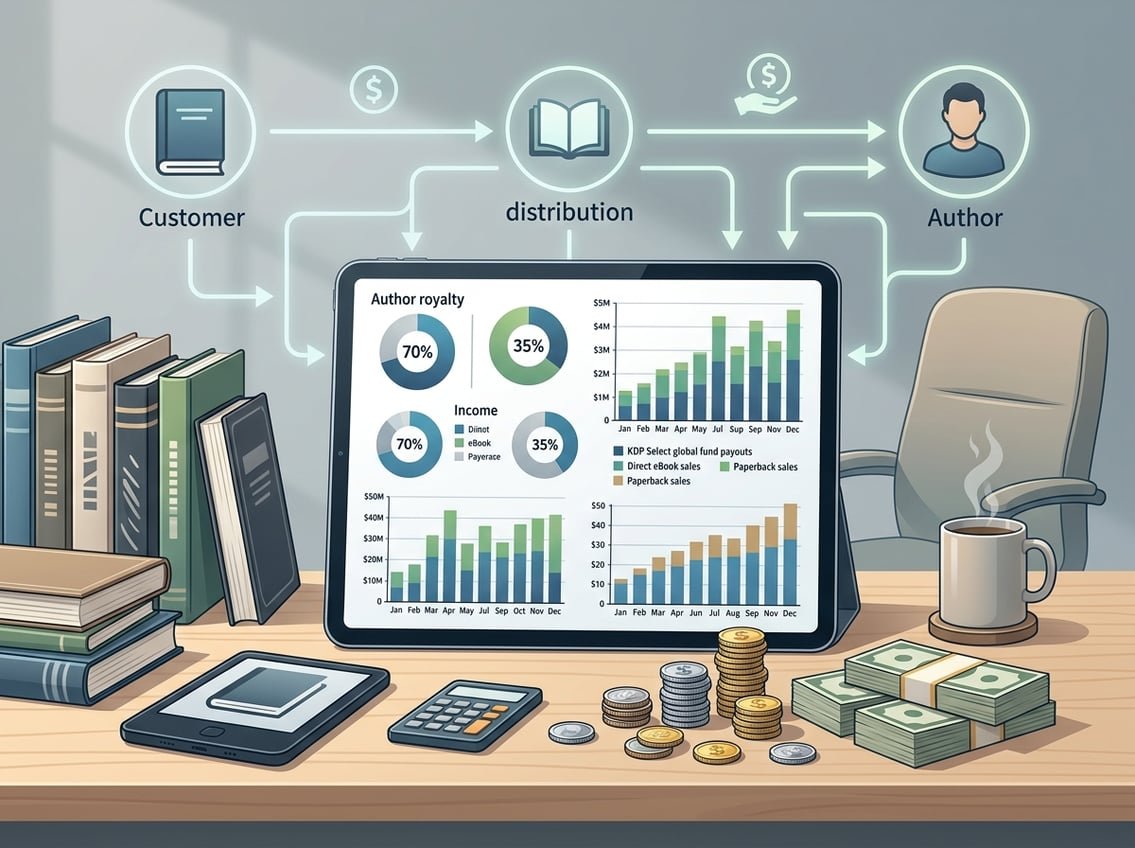
Amazon KDP offers multiple ways to earn money from your books, but the exact amount you keep depends on your pricing choices, book format, and whether you enroll in Kindle Unlimited. The royalty rates range from 35% to 70% for eBooks, while print books follow a different calculation based on printing costs.
70% Royalty Versus 35% Royalty
Amazon gives you two royalty options for eBooks: 35% and 70%. The 70% tier sounds amazing, but it comes with strict rules. Your book must be priced between $2.99 and $9.99 to qualify.
If you price your eBook at $0.99 or above $9.99, you automatically fall into the 35% tier. The 70% option also requires you to enroll in certain Amazon marketplaces and match your lowest list price across all sales channels.
Many authors choose the 70% tier because it maximizes earnings in the sweet spot pricing range. A book priced at $4.99 earns you $3.49 per sale at 70%, compared to just $1.75 at 35%. The difference adds up quickly when you start selling dozens or hundreds of copies per month.
KDP Royalties for eBooks and Paperbacks
eBooks and paperbacks use completely different royalty systems. For eBooks, you earn a percentage of your list price based on which tier you choose. Paperbacks earn you 60% of your list price minus the printing cost.
Here’s how paperback math works: If you sell a 200-page black-and-white paperback for $12.99, Amazon takes 40% ($5.20) and then deducts printing costs (around $3.65 for a standard size). Your net royalty is about $4.14 per copy.
| Format | Royalty Rate | Price Range | Key Deduction |
|---|---|---|---|
| eBook | 70% | $2.99-$9.99 | Delivery fee |
| eBook | 35% | Any price | None |
| Paperback | 60% | Variable | Printing cost |
Print books require careful pricing to stay profitable. You need to ensure your list price covers both Amazon’s cut and printing costs while still leaving you with meaningful earnings per sale.
Kindle Unlimited and KENP Payouts
Kindle Unlimited changes your income model entirely. Instead of selling individual copies, you earn roughly $0.004 per page read through the KENP system. KENP stands for Kindle Edition Normalized Pages, which is how Amazon counts pages.
When you enroll in KDP Select, your eBook becomes exclusive to Amazon for 90 days. In return, Kindle Unlimited subscribers can read your book for free, and you get paid from a global fund. A 300-page book read from start to finish earns you about $1.20.
Many successful publishers generate most of their income from KENP rather than direct sales. Readers are more willing to try unknown authors when they can read for free with their subscription. This lower barrier often results in more total earnings even though the per-book payout is smaller.
Delivery Fee and Other Deductions
The 70% royalty tier includes a delivery fee based on your eBook file size. Amazon charges about $0.15 per megabyte to deliver your book to customers. For a typical text-only novel, this fee is minimal, usually just a few cents.
However, illustrated books or cookbooks with high-resolution images can rack up delivery fees quickly. A 50 MB file costs you $7.50 per sale in delivery charges. This can completely wipe out your profits if you’re not careful with file optimization.
You can reduce delivery fees by compressing images, choosing appropriate file formats, and removing unnecessary embedded fonts. Some authors calculate whether switching to the 35% tier (which has no delivery fee) actually earns them more money for image-heavy books.
Costs and Investments for Beginners

Starting with Kindle Publishing Income requires more than just the course fee. You’ll need money for outsourcing, advertising, and tools to find profitable book ideas and reach readers.
Upfront and Ongoing Expenses
The Kindle Publishing Income course costs $1,997 upfront or $799 per month for three months. That’s just your entry point into the program.
Once you’re inside, you’ll need to budget for creating your books. Most students outsource writing to freelancers, which typically costs between $800 and $1,200 per book. This covers writing, editing, and cover design. If you want to publish multiple books quickly, these costs add up fast.
You’ll also need money for Amazon ads to promote your books. Most beginners start with $50 to $100 per month per book, though some spend more to see faster results. These are ongoing expenses that don’t stop after your first month.
Beyond the course and book creation, you might invest in additional tools or services. Some students hire virtual assistants or pay for extra coaching. The total investment in your first few months can easily reach $3,000 to $5,000 or more.
Using Niche Finder and Keyword Tools
The course includes niche finder software to help you identify profitable book categories. This tool shows you which topics have high demand and low competition on Amazon KDP.
You’ll use these tools to research keywords and book ideas before you spend money on outsourcing. The goal is to find niches where your book can rank well and generate sales without competing against thousands of established authors.
Sophie Howard provides her list of vetted freelancers and resources to help you move faster. You don’t have to guess which writers or designers to hire. This saves time and reduces the risk of wasting money on poor-quality work.
Some students also buy additional keyword research tools outside the course. These aren’t required but can give you more data for making decisions about which books to publish.
Listing Optimization and Amazon Ads
Getting your book published is only half the battle. You need to optimize your book listing with the right title, description, and keywords so readers can find it.
Amazon advertising is where most beginners spend their ongoing budget. You’ll create ads that show your book to people searching for related topics. The course teaches you how to set up and manage these campaigns, but you’ll need to budget for the ad spend itself.
Your ads compete with millions of other books, so you can’t just publish and hope for sales. You need consistent advertising to get visibility. Many students spend $100 to $300 per month across multiple books to see meaningful results.
Building an email list is another strategy Sophie teaches. This lets you reach readers directly and promote new books without relying only on Amazon ads. However, you’ll still need Amazon advertising to get your first sales and reviews.
Niche Selection and Low-Content Books
Picking the right niche and understanding low-content book opportunities are crucial for making money with Kindle publishing. Your success depends on finding markets with good demand but manageable competition, then deciding whether low-content or high-content books fit best.
Choosing Profitable Niches
You need to look at three main factors when picking a niche: profit margins, market demand, and competition level. A good niche lets you price books at $8.99 or higher while keeping printing costs low enough to earn solid royalties.
Check the Best Seller Rank (BSR) of top books in your target niche. Books with a BSR under 100,000 typically sell consistently. A BSR around 50,000 often means 10-30 sales per day.
Look at review counts on competing books. If top results have fewer than 200 reviews, you have a better chance to compete. Niches like large print activity books for seniors and pet care logs show strong demand with lower competition than saturated markets.
Avoid these oversaturated niches:
- Generic password logbooks
- Basic lined notebooks
- Simple coloring books
- Blank recipe journals
You can use niche finder software to speed up your research. These tools help you analyze BSR data, estimate sales, and compare competition levels across different categories. Some publishers invest in a low content masterclass to learn proven research methods, though you can also do effective research using free tools and manual checking.
Low-Content Books: Opportunities and Challenges
Low-content books include planners, journals, logbooks, and activity books with mostly blank or templated pages. These books cost less to create than full manuscripts since you design interiors once and can modify them for different niches.
Your main opportunity is speed. You can publish a quality low-content book in 1-2 weeks versus months for a traditional book. This lets you test multiple niches quickly and build a catalog faster.
The challenge is competition. Many publishers flood popular categories with similar products. You need to stand out through better covers, smarter keywords, or by targeting specific sub-niches.
Specialized planners work better than generic ones. Instead of a basic daily planner, create a meal prep planner for bodybuilders or a budget planner for college students. Pet care trackers perform well when you focus on specific animals rather than “all pets.”
Your profit margins on low-content books typically range from $3 to $7 per sale depending on your pricing and page count. A 120-page gratitude journal priced at $13.99 might earn you around $6 per sale after printing costs.
High-Content Versus Low-Content Strategies
High-content books contain substantial written material like novels, how-to guides, or cookbooks with full recipes. Low-content books provide structure and templates for readers to fill in themselves.
Low-content advantages: Faster production, no writing skills needed, easier to scale, lower upfront time investment.
High-content advantages: Less competition in many niches, higher perceived value, better pricing flexibility, stronger customer loyalty.
You can earn good income with either approach. Low-content publishers often aim for volume, building catalogs of 20-50+ books to generate $3,000-$10,000 monthly. High-content publishers might earn similar amounts from just 5-10 well-performing books.
Your choice depends on your skills and goals. If you enjoy writing or have expertise to share, high-content books let you charge premium prices and build authority. If you prefer design work and want to scale quickly, low-content books offer a faster path to your first sales.
Many successful publishers use both strategies. They might create low-content books to generate steady base income while working on high-content projects that command higher prices and royalties.
Program Analysis: Sophie Howard and Related Courses
Sophie Howard’s Kindle Publishing Income teaches you how to create an income stream through Amazon’s self-publishing platform without writing books yourself. The program costs $2,485 and includes video training modules, weekly live classes, and one-on-one check-ins.
Kindle Publishing Income Course Overview
The Kindle Publishing Income program launched in mid-2021 and contains 6 video training modules. You learn how to publish books on Amazon KDP by hiring ghostwriters and outsourcing the production process. The course walks you through business foundations first, then shows you how to find profitable book topics and manage the publishing workflow.
Your membership includes access to weekly live group calls where you can ask questions. You also get three personal check-in sessions with Sophie Howard or her team. The program provides tools and resources you download as you complete each lesson.
When you join, you start with Milestone 1 called Business Foundations. You need to finish each lesson’s assignments before moving forward. The training is designed for beginners who have never published on Amazon before.
Pros and Cons of the Program
Advantages:
- Beginner-friendly structure with step-by-step guidance
- Access to weekly live calls for ongoing support
- Three one-on-one coaching sessions included
- No writing required since you hire ghostwriters
- Tools and templates provided throughout the course
Drawbacks:
- High upfront cost at $2,485
- Course content described as “quite light” for the price
- Success depends on how closely you manage outsourced work
- Quality control rests entirely on your standards
- Ongoing costs for ghostwriters and book production not included
The program gives you a framework to follow, but your results depend on your own effort and quality standards. You still need to invest time managing freelancers and overseeing each book project.
Sophie Howard’s Strategies and Reputation
Sophie Howard is originally from the UK and now lives in New Zealand. She first built her reputation with Amazon FBA before creating the Kindle Publishing Income course. She’s known online as a seven-figure digital entrepreneur and bestselling author.
Her main strategy focuses on finding profitable niches in the Amazon marketplace. You learn to identify book topics with demand but lower competition. Instead of writing yourself, you hire ghostwriters to create the content while you manage the business side.
Sophie Howard also created other programs including the Audible Profit Multiplier and International Profit Multiplier. Her team has worked with thousands of students since launching the publishing program. The program has a Trustpilot page with 2,050 customer reviews as of the search results.
Comparing Other KDP Training Options
Many Amazon KDP training programs exist at different price points. Some courses cost under $500 and teach similar concepts about niche research and outsourcing. Others charge $3,000 or more and include more extensive coaching.
Most KDP courses cover the same basic topics: keyword research, cover design, ghostwriter hiring, and book formatting. The main differences come down to support level and how detailed the training gets. Lower-priced options usually give you video lessons without personal coaching. Higher-priced programs offer more hand-holding through the process.
You should consider how much support you need before choosing a program. If you’re comfortable figuring things out independently, you might not need the premium price tag. The fundamentals of Amazon KDP publishing are available through free YouTube videos and Amazon’s own resources.
Frequently Asked Questions
People considering Kindle Publishing Income have real concerns about costs, legitimacy, support, and actual earning potential. These questions reflect what matters most when deciding if this program fits your goals and budget.
Is this program legitimate, or does it have red flags I should know about?
Kindle Publishing Income is a legitimate course created by Sophie Howard, a known figure in the Amazon selling space. The program teaches real strategies for publishing books on Amazon KDP without writing them yourself.
However, there are some concerns you should know about. Several students have reported strict refund conditions that made it hard to get their money back. You need to complete all the training, publish at least one book, and prove you tried everything before qualifying for the 180-day guarantee.
Some users mention high-pressure sales tactics and upsells during the signup process. Others feel the true costs of running a Kindle business weren’t fully explained upfront. The business model itself is real and works for some people, but results vary widely based on your effort and investment.
What do people on Reddit say about their real results and experience with it?
Reddit users share mixed opinions about Kindle Publishing Income. Some express skepticism about the program’s cost and question whether you need to pay nearly $2,000 for information available free online.
Critical voices mention issues with support quality and getting timely help from coaches. A few users report feeling disappointed when they realized how much additional money they’d need for outsourcing and advertising. Others point out that the Kindle publishing market has become much more competitive since the course launched, making it harder to replicate Sophie’s success.
Not all feedback is negative. Some students share that the structure and community helped them stay accountable. However, most honest discussions acknowledge that success requires significant time, money, and consistent effort beyond what the marketing suggests.
How does the training or membership actually work, and what’s included?
The course is organized into six core modules that cover the entire Kindle publishing process. You start with foundation training on Amazon KDP, then move through mindset development, book idea research, outsourcing content creation, sales strategies, and Amazon advertising.
You get access to Sophie’s list of vetted freelancers, weekly group coaching calls, and a private Facebook community. The program includes bonus tools like niche finder software and masterclasses on public domain books and low-content publishing. There’s also support from a VIP concierge team to help answer questions.
All training is delivered online through video lessons and written materials. You work through the modules at your own pace, though completing everything and implementing the strategies takes several weeks or months depending on your schedule.
What does it cost to join, and are there upsells or recurring fees?
The course costs $1,997 if you pay upfront, or $799 per month for three months on a payment plan. Some sources list it at $2,485 with a five-month payment option.
Beyond the course fee, you need money for outsourcing book creation. Each book typically costs $800 to $1,200 when hiring ghostwriters, editors, and cover designers. You’ll also need a monthly budget for Amazon ads, usually starting at $50 to $100 per month but often more if you want meaningful results.
Some students report feeling pressured by upsells during the signup process. The initial course price doesn’t cover everything you need to actually run the business, which catches many people off guard.
How long does it usually take to start earning money, and what factors affect results?
Most students don’t see significant income for several months after publishing their first book. Building a profitable Kindle business typically requires publishing multiple books and running consistent advertising campaigns.
Your results depend heavily on how much you invest in quality content and marketing. Books in competitive niches need larger ad budgets to gain visibility among millions of other titles on Amazon. You also need to keep publishing new books regularly since one-off titles rarely generate substantial long-term income.
Success also depends on your ability to research profitable niches, hire good freelancers, and optimize your book listings. Some students report making $200 to $300 per day in net profit from just three books, but these results aren’t typical. Most beginners struggle to break even in their first year.
Can beginners do this without prior publishing experience, and what skills or tools are needed?
The course is designed for complete beginners with no writing or publishing background. Sophie’s training walks you through every step, from finding book ideas to uploading finished books to Amazon.
You don’t need to write books yourself since the strategy relies on outsourcing. However, you do need basic computer skills and the ability to manage freelancers. You’ll also need to learn how to research book niches, analyze competition, and run Amazon ad campaigns.
The most important requirement is having enough startup capital for both the course and the business expenses. You also need patience and persistence since building a profitable publishing business takes months of consistent effort and multiple book launches.